
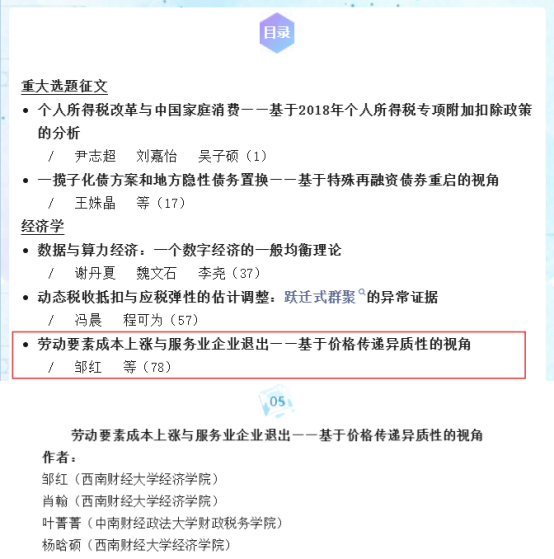
Recently, Ye Jingjing, a researcher at the Center for International Cooperation and Disciplinary Innovation of Income Distribution and Public Finance of Zhongnan University of Economics and Law, officially published a co-authored paper, “Rising Labor Costs and the Exit of Service Firms: A Perspective Based on Heterogeneity in Price Pass-through”, in the prestigious journal Journal of Management World (Issue 3, 2026). Her collaborators include Zou Hong, Xiao Han, and Yang Hanshuo from the School of Economics at Southwestern University of Finance and Economics.
Abstract:
Under the impact of rising labor factor costs and other shocks, service firms in China are facing high exit rates and a significant reduction in survival duration. However, existing selection theories, which focus on improving internal production efficiency, are insufficient to fully explain the high exit phenomenon among service sector enterprises. Closely incorporating the characteristics of the service sector, such as being labor-intensive, difficult to scale, and highly differentiated, this paper proposes that the external perspective of cost-price pass-through is the key to understanding the exit behavior of service firms. Based on industrial and commercial registration data for service firms and service price data, the study utilizes the minimum wage policy as an exogenous shock to labor factor costs. The research finds that for every 10% increase in labor costs, the profit margins of firms decrease by an average of 0.63%, and the number of deregistered firms at the district/county-industry level increases by 2.6. This policy impact is particularly significant in traditional services and non-digitalized enterprises with weaker price adjustment capabilities. Counterfactual simulations further reveal that if the entire service sector attained the price adjustment capacity of modern services, the short-term cost shock could be offset by 24.2%. This study provides both theoretical and empirical evidence for establishing a "quality-based pricing" system in the service market. Furthermore, it offers practical insights into enhancing the operational stability of traditional service firms through digital transformation.
About the Author:

Ye Jingjing is a professor and doctoral advisor at Zhongnan University of Economics and Law and a researcher at the Center for International Cooperation and Disciplinary Innovation of Income Distribution and Public Finance supported by the Ministry of Education and the Ministry of Human Resources and Social Security. She holds a Ph.D. from Southern Methodist University, USA. Her research focuses on tax administration and national governance, fiscal expenditure, and subsidy design. Her related findings have been published in authoritative domestic and international journals such as Journal of Management World, The Journal of World Economy, China Economic Quarterly, Journal of Banking and Finance, Urban Studies, and China Economic Review. She has been selected for provincial-level talent programs and as a candidate for academic and technical leadership. She has led and participated in four major projects funded by the National Social Science Fund of China, one project funded by the National Natural Science Foundation of China, one project funded by the Ministry of Education Foundation on Humanities and Social Sciences, and more than ten other national and provincial/ministerial-level projects. Her research achievements have won several awards, including the Excellent Paper Award from the Camphor Tax Forum, the Chinese Society of Technology Economics, the Fiscal Forum, and the China Association of Labor Economics. The research results from her practical investigations have been widely reposted and reported by media outlets such as Beijing News and Xinhuanet, creating a positive social impact.