
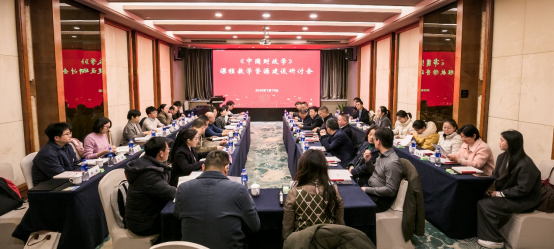
On January 10, 2026, the Seminar on Teaching Resource Development for the Course of Chinese Public Finance, a key original Chinese philosophy and social science textbook compiled by Zhongnan University of Economics and Law (ZUEL), was successfully held at Jiangxi University of Finance and Economics. This event was jointly hosted by the School of Public Finance and Taxation at ZUEL, the Center for International Cooperation and Disciplinary Innovation of Income Distribution and Public Finance (111 Center), and the School of Public Finance and Taxation at Jiangxi University of Finance and Economics. It aims to advance the transformation of the textbook Chinese Public Finance from a textual achievement into a high-quality teaching system, thereby strengthening the foundation for cultivating public finance professionals in the new era.
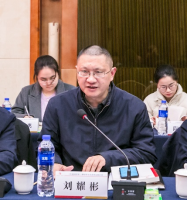
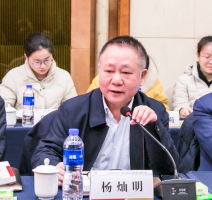
Liu Yaobin, Secretary of the CPC Committee of Jiangxi University of Finance and Economics, and Yang Canming, Editor-in-Chief of Chinese Public Finance and former President of ZUEL, delivered opening remarks at the seminar. In his address, Liu Yaobin extended a warm welcome on behalf of Jiangxi University of Finance and Economics to the attending experts and representatives of faculty and students. He used three superlatives to highly commend the significant importance of developing Chinese Public Finance, a key original Chinese philosophy and social science textbook, and the remarkable efforts of the textbook compilation team. Meanwhile, he extended warm congratulations on the publication and distribution of Chinese Public Finance. In his address, Yang Canming recounted the compilation process of Chinese Public Finance and expressed gratitude to the experts, scholars, and relevant institutions that participated in and supported the project. He noted that all members of the compilation team should treat the publication of Chinese Public Finance as a new starting point, diligently carry out follow-up tasks, and focus on developing course teaching resources.
Subsequently, the seminar focused on the systematic, standardized, and high-quality development of teaching resources for the course of Chinese Public Finance, covering aspects such as courseware production, problem-solving approaches for reflection questions, and the development of teaching plans and examination question banks. Wang Qiao, Deputy Editor-in-Chief of Chinese Public Finance and former Secretary of the CPC Committee of Jiangxi University of Finance and Economics, presided over the first half of the seminar. Ma Xiao, Deputy Editor-in-Chief of Chinese Public Finance and former Deputy Secretary of the CPC Committee of Southwestern University of Finance and Economics, presided over the second half. Various individuals delivered presentations at the seminar, including Professor Li Ming, Assistant to the President and Dean of the School of Government at the University of International Business and Economics; Professor Lu Yuanping, Director of the Academic Affairs Office and Dean of the School of Public Finance and Taxation at ZUEL; Professor Liu Rong, former Dean of the School of Public Finance and Taxation at Southwestern University of Finance and Economics; Professor Li Xiangyun from the School of Public Finance and Taxation at ZUEL; Professor Zhou Keqing from the School of Public Finance and Taxation at Southwestern University of Finance and Economics; Professors Tian Binbin and Qi Yu, Deputy Deans of the School of Public Finance and Taxation at ZUEL; Professor Xiao Jianhua and Professor Wan Ying from the School of Public Finance and Taxation at Jiangxi University of Finance and Economics; Associate Professor Zhu Cuihua, Deputy Dean of the School of Public Finance & Taxation of Guangdong University of Finance & Economics; and Gao Sihan, Researcher at the 111 Center.
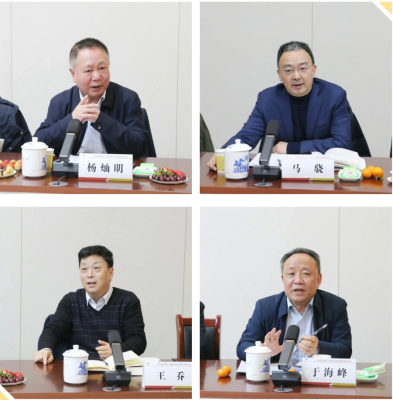
Yang Canming, Editor-in-Chief of Chinese Public Finance; Ma Xiao and Wang Qiao, Deputy Editor-in-Chief; and Professor Yu Haifeng, a member of the textbook compilation team and former President of Guangdong University of Finance & Economics, delivered guidance speeches at the seminar. According to Yang Canming, the development of courseware, problem-solving approaches for reflection questions, teaching plans, and examination question banks holds significant importance. These materials serve as functional extensions of the textbook and act as vital bridges that connect the textbook to classroom instruction. He emphasized that the textbook compilation team must promptly revise and refine the courseware based on the seminar's discussions, pay close attention to feedback from trial lectures and pilot testing, and lay a solid foundation for the effective implementation of the textbook. Ma Xiao proposed that course development should keep pace with the times, suggesting the inclusion of guiding principles from the fourth plenary session of the 20th CPC Central Committee. He stressed the need to base content on the textbook, attach great importance to the logical connections between chapters, emphasize key points and highlights, and fully demonstrate the essence and mission of public finance. According to Wang Qiao, since this textbook is intended for undergraduate students, the courseware must be developed with full respect for their foundational knowledge. Moreover, proper flexibility must be maintained to allow instructors sufficient room for independent innovation. Yu Haifeng suggested that courseware formats should be unified, primarily showcasing key knowledge points, theoretical frameworks, and logical structures. Meanwhile, content layouts should be concise and highlight key points, taking into account variations in teaching hours and emphasis across different majors.
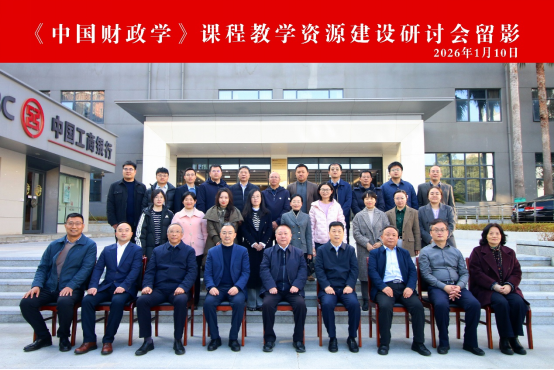
This seminar has pooled the wisdom of leading experts in China's public finance community. It has established a clear direction for teaching resource development: guided by the spirit of the times, oriented to undergraduate education, and focused on refining the logical framework. This provides practical guidance for enhancing the courseware, teaching plans, reflection questions, and examination question banks for the textbook Chinese Public Finance. As a national-level disciplinary innovation platform, the 111 Center will continue to play its connecting role. It will collaborate to advance the iterative upgrading of teaching resources for Chinese Public Finance, helping to build a world-class public finance education system with Chinese characteristics. These efforts will provide robust support for constructing China's independent knowledge system and cultivating high-caliber public finance professionals in the new era.