
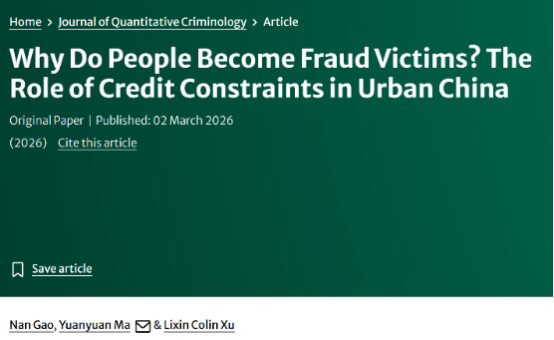
Recently, Ma Yuanyuan, a researcher at the Center for International Cooperation and Disciplinary Innovation of Income Distribution and Public Finance of Zhongnan University of Economics and Law, officially published a co-authored paper, "Why Do People Become Fraud Victims? The Role of Credit Constraints in Urban China", in the prestigious international journal Journal of Quantitative Criminology. She serves as the corresponding author of the study, and her collaborators include Gao Nan from ZUEL and Xu Lixin from the Cheung Kong Graduate School of Business. The Journal of Quantitative Criminology is a world-renowned SSCI journal in the social sciences, enjoying extensive academic influence within the international community.
Highlights:
Utilizing data from the China Household Finance Survey, the study provides an in-depth exploration of the link between household credit constraints and the risk of fraud victimization. The research reveals that credit constraints significantly increase the likelihood of individuals falling victim to fraud by inducing impatience and encouraging high-risk borrowing behaviors. This finding extends the real-world effects of financial markets into the realm of social governance, enriching the economic determinants of victimization theory. Furthermore, it provides vital policy implications for fraud prevention through the implementation of financial inclusion polic
About the Author:

Ma Yuanyuan is a professor and doctoral advisor at Zhongnan University of Economics and Law and a researcher at the Center for International Cooperation and Disciplinary Innovation of Income Distribution and Public Finance supported by the Ministry of Education and the Ministry of Human Resources and Social Security. She has been recognized as a top young professional in Hubei Province and as a Young Scholar of the Wenlan Scholar Program. Her main research areas include health economics, population economics, and public economics. She has published more than 20 papers in prestigious domestic and international journals, including Demography, Journal of Health Economics, Journal of Comparative Economics, Journal of Quantitative Criminology, Journal of Happiness Studies, Health Economics, World Development, The Journal of World Economy, and Finance & Trade Economics. She has led and participated in several projects funded by the National Natural Science Foundation of China and the National Social Science Fund of China. Professor Ma has received the second prize for the Hubei Provincial Social Science Outstanding Achievement Award, the Outstanding Achievement Award in Philosophy and Social Sciences of Higher Education Institutions in Hubei Province, and the first prize for the Hubei Provincial Population Science Award, among other honors. She serves as a member of the Economic Professional Committee of the Hubei Provincial Committee of the China Association for Promoting Democracy and a council member of the China Association of Labor Economics. Her international engagements include serving as a teaching evaluation expert at University College Dublin. Furthermore, she is a peer reviewer for the National Natural Science Foundation of China and the National Social Science Fund of China. She also holds the position of Associate Editor for the SSCI-indexed journal Economics and Human Biology.