
The 23rd Wenlan Public Finance and Taxation Lecture took place in Conference Room 415, North Wenquan Building, on the afternoon of March 30. Professor Wang Liming, Director of the UCD Irish Institute for Chinese Studies, delivered a lecture titled From the Needham Puzzle to the Rise of AI: The Relationships Among Language, Mathematical Thinking, and Brain Function. Moderated by researcher Ma Yuanyuan from the Center for International Cooperation and Disciplinary Innovation of Income Distribution and Public Finance, the event drew researchers from the Center, alongside faculty and graduate students from the School of Public Finance and Taxation.
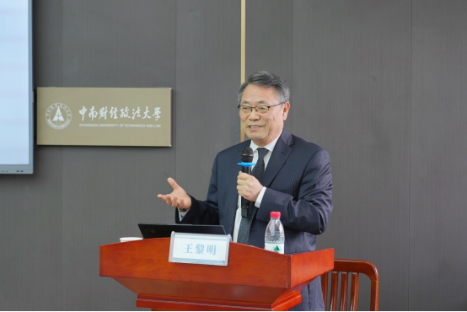
Professor Wang Liming began by defining the Needham Puzzle and reviewing existing explanations. Citing the strong performance of Chinese students in statistics and math competitions, he illustrated the differences in writing systems, grammar, and cognitive processes between Chinese and Western languages. He then analyzed the relationships among language, mathematical thinking, and brain function. He noted that alphabetic and logographic writing systems develop different mathematical thinking abilities. As a logographic script, Chinese enhances visual thinking, while alphabetic languages foster abstract and logical reasoning. Experiments show that reading and listening to Chinese engage both the left and right hemispheres of the brain more actively. Furthermore, performing mathematical calculations in English activates more brain regions than doing so in Chinese.
Based on research findings, Professor Wang Liming concluded that the interplay of language, mathematical thinking, and brain function fundamentally explains the Needham Puzzle. He suggested leveraging the comparative advantages of the Chinese language in developing neural networks and large language models to advance research and applications in cognitive science and AI. Additionally, he advocated for wider promotion of Chinese language learning overseas for its cognitive benefits.
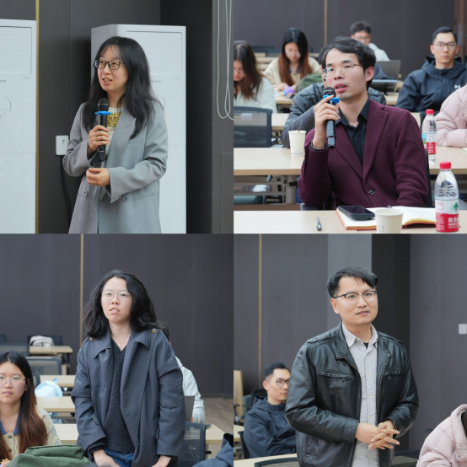
During the event, faculty and students engaged in in-depth discussions with Professor Wang Liming on topics such as whether bilingual learning contributes to research in the natural and social sciences. The atmosphere was lively, and participants found the exchange highly rewarding.
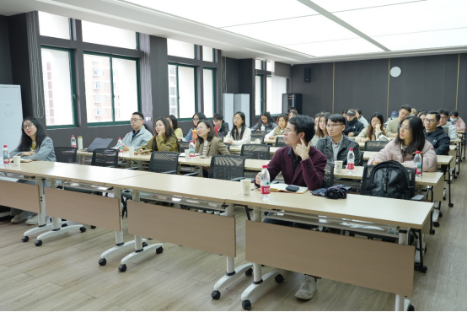
To conclude, researcher Ma Yuanyuan summarized the lecture and thanked Professor Wang Liming for his insightful presentation. The successful lecture deepened participants' understanding of the relationships among language, mathematical thinking, and brain function, fostering a vibrant scholarly atmosphere on campus.
(Correspondent: Lei Guangyi; Photographer: Feng Jiaqi)