
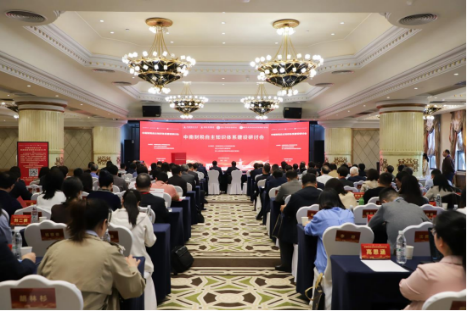
On April 26, the Seminar on Building an Independent Knowledge System for Public Finance and Taxation at ZUEL took place in Wuhan. The event was co-hosted by the School of Public Finance and Taxation at Zhongnan University of Economics and Law (ZUEL), the Economics and Management School at Wuhan University, and the Center for International Cooperation and Disciplinary Innovation of Income Distribution and Public Finance. Over 100 leading scholars, experts, and industry professionals in public finance and taxation from more than a dozen universities and research institutes nationwide gathered in Wuhan. Attendees explored the development path for China's independent knowledge system for public finance and taxation, engaging in in-depth discussions on core issues such as the development of the independent knowledge system, theoretical innovation, policy practice, and talent cultivation.
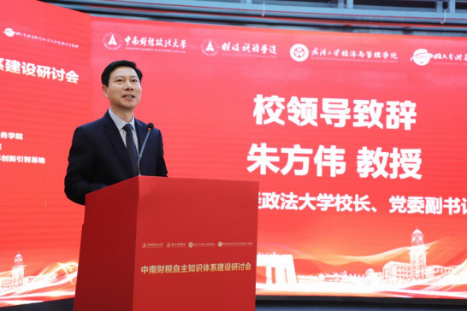
During the opening ceremony, Professor Zhu Fangwei, President and Deputy Secretary of the CPC ZUEL Committee, highlighted that the seminar aligns with China's critical efforts to strengthen its educational system and build an independent knowledge system for philosophy and social sciences. Focusing on building an independent knowledge system for public finance and taxation at ZUEL, the event systematically reviewed the public finance and taxation disciplines' nearly 80 years of academic heritage at ZUEL and envisioned the disciplines. More importantly, it demonstrated a proactive commitment to addressing contemporary challenges based on China's realities. Taking this seminar as an opportunity, ZUEL will fully support the development of its public finance and taxation disciplines and deepen partnerships with peer institutions. Bound by Professor Wu Junpei's academic philosophy, the university aims to jointly advance China's independent knowledge system for public finance and taxation disciplines, contributing its strength to national strategies and educational excellence.
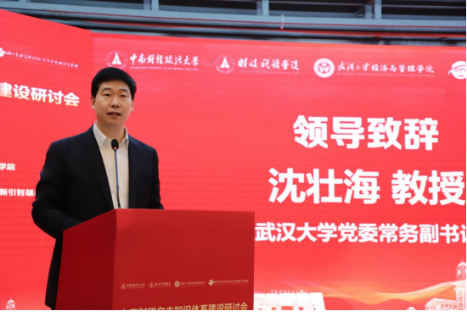
"Building China's independent knowledge system has become a major task for philosophy and social sciences in the new era," stated Professor Shen Zhuanghai, Executive Deputy Secretary of the Party Committee of Wuhan University. He emphasized that as public finance and taxation disciplines are foundational to national governance, developing an independent knowledge and discourse system for these disciplines is essential to advancing high-quality development of finance and economics with Chinese characteristics and modernizing the national governance system. This seminar holds profound practical and historical significance by driving in-depth discussions on independent public finance theories of the independent knowledge system and institutional arrangements tailored to China's specific conditions. Wuhan University will continue to deepen inter-university collaboration and pursue genuine scholarship, playing its part in building China's independent knowledge system for public finance and taxation.
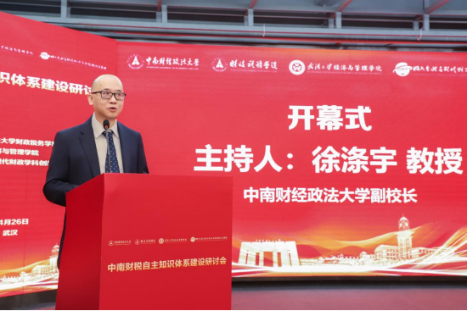
Professor Xu Diyu, Vice President of ZUEL, presides over the opening ceremony.
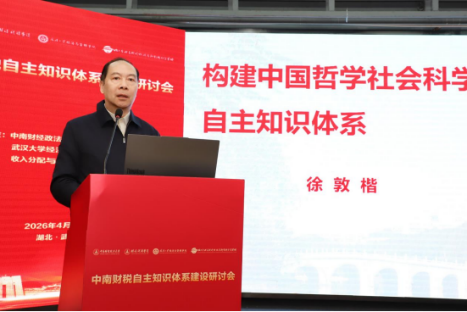
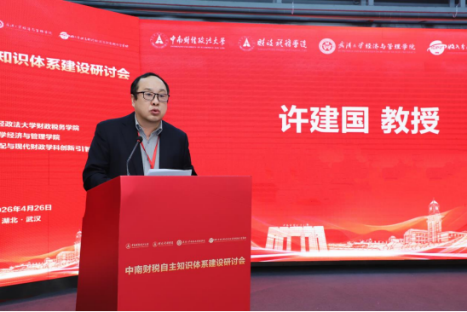
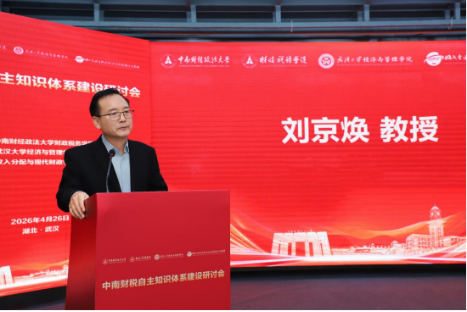
Professor Gao Peiyong, former Vice President and Member of the Academic Divisions of the Chinese Academy of Social Sciences (CASS), attended the event upon invitation. The opening ceremony featured a special segment reviewing the historical development of an independent knowledge system for public finance and taxation at ZUEL. Professor Xu Dunkai (former Secretary of the CPC ZUEL Committee), Professor Xu Jianguo (former President and Deputy Secretary of the CPC Committee of Hubei University of Economics), and Professor Liu Jinghuan (former Vice Dean of the School of Public Finance and Taxation at ZUEL) delivered thematic speeches on Professor Wu Junpei's public finance and taxation philosophy. Professor Xu Diyu, Vice President of ZUEL, presided over the opening ceremony.
During the keynote session, speeches were successively delivered by Professor Wu Junpei, former President of ZUEL, former Vice President of Wuhan University, and Honorary Director of the Centre of Finance Research of Wuhan University; Professor Deng Liping, member of the Standing Committee of the 13th National People's Congress, former Vice Chairman of the Standing Committee of Fujian Provincial People's Congress, and former President of Xiamen National Accounting Institute; Professor Fan Liming, former President and Deputy Secretary of the Party Committee of Shandong University; Researcher Liu Shangxi, former Secretary of the Party Committee and President of the Chinese Academy of Fiscal Sciences; Professor Ma Haitao, President and Deputy Secretary of the CPC Committee of Central University of Finance and Economics; Professor Xia Jiechang, former Vice President and Second-Level Researcher of the National Academy of Economic Strategy at CASS; and Professor Yang Canming, former President and Deputy Secretary of the CPC ZUEL Committee. Professor Lu Yuanping, Director of the Academic Affairs Office and Dean of the School of Public Finance and Taxation at ZUEL, moderated the keynote session.
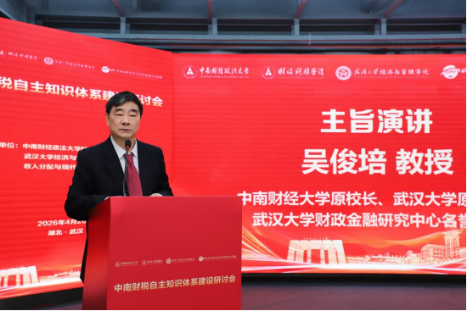
Professor Wu Junpei delivered a keynote speech titled Exchange and Labor Cultures Are Fundamental Drivers of Historical Development, exploring the proposition from four progressive perspectives. First, he identified the essence of culture as humanization, noting that without exchange, there is no division of labor and cooperation, and therefore no culture; thus, exchange and labor cultures jointly propel historical development. Second, from a historical perspective, he argued that exchange inherently embodies the division of labor and cooperation—the two fundamental categories of economics. Third, philosophically, he contended that paradigm shifts from classical mechanics to relativity and quantum mechanics reveal exchange as the constant root of change. Fourth, he proposed that modern economics stems from the convergence of Eastern and Western cultures, illustrating how this convergence has shaped modern economics and institutional evolution at key historical junctures. He advocated building an independent knowledge system for Chinese public finance on the convergence of Eastern and Western cultures. Guided by Marxist thought, this system should adopt exchange and labor cultures as core perspectives to drive disciplinary innovation.
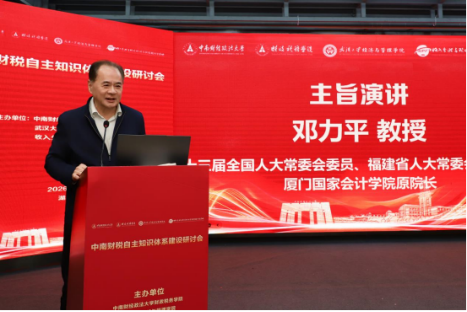
Professor Deng Liping presented a keynote titled Embracing New Ideas and Forging Ahead: Contributing to High-Quality Development. He discussed three interrelated topics: the development of China's independent knowledge system for public finance and taxation, the ZUEL School, and the academic contributions of discipline leaders. He also paid high tribute to Professor Wu Junpei and other founders of ZUEL's public finance and taxation disciplines for their outstanding contributions. He emphasized that building this independent knowledge system must be fundamentally guided by the latest achievements in adapting Marxism to the Chinese context and the needs of our times. Amid accelerating global changes unseen in a century and deepening cultural diversity, we must strengthen our cultural confidence to forge a discourse system rooted in Chinese heritage yet capable of global dialogue. Furthermore, balancing high-quality development with high-level security, opening up, and modern national governance will yield greater contributions to innovating China's public finance and taxation theories and practices.
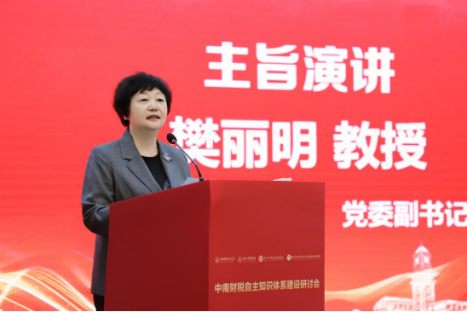
Professor Fan Liming delivered a keynote titled How to Build an Independent Knowledge System for China's Public Finance. She systematically outlined the four developmental stages of China's public finance since the founding of the People's Republic of China. Drawing on Professor Wu Junpei's nearly six decades of academic exploration, she distilled four essential academic attitudes and approaches required for building this independent knowledge system. First, Seeking Truth: upholding facts and independent thinking, with the courage to question, rigor in verification, and a willingness to debate. Second, Tracing Origins: emphasizing foundational theories and core issues. Third, Integration: transcending disciplinary boundaries, synthesizing knowledge, and embracing diverse perspectives in public finance studies. Fourth, Perseverance: relentlessly advancing the systematic development of China's public finance discipline.
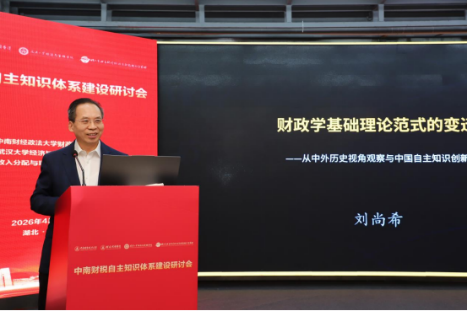
Researcher Liu Shangxi delivered a keynote titled Tracing Paradigm Shifts in Foundational Public Finance Theories. He noted that research in philosophy and the social sciences should embrace the transformative spirit of the natural sciences, shifting its worldview from certainty to uncertainty. Drawing on the quantum mechanics concept that uncertainty is the essence of the world, he addressed Professor Wu Junpei's proposition on exchange culture, emphasizing that exchange is made possible only through a human consensus on values and the joint creation of social rules. After systematically reviewing the evolution of foundational public finance paradigms, he proposed that in a risk society, the underlying logic of public finance must shift from certainty to uncertainty. This requires re-examining the socialization of public risks, public finance boundaries, and institutional arrangements through a risk-oriented lens, ultimately building China's independent knowledge system for public finance centered on risk governance.
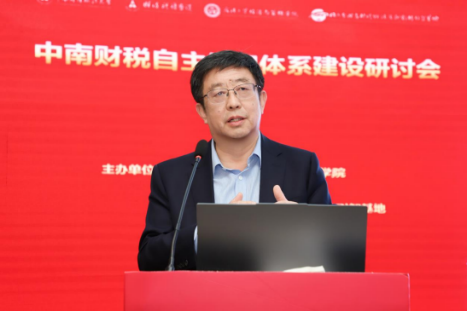
Professor Ma Haitao delivered a keynote titled Carrying Forward Professor Wu Junpei's Academic Philosophy to Innovate China's Foundational Public Finance Theories. He outlined Professor Wu Junpei's public finance philosophy, highlighting his continuous research on fundamental public finance issues, his focus on the practical outcomes of public finance expenditure management, and his holistic approach to the top-level design of the tax system. He also summarized Professor Wu Junpei's major contributions to the discipline, particularly his role in driving theoretical innovation, integrating institutional and theoretical research, and developing both the academic discipline and talent cultivation systems. He described Professor Wu Junpei's public finance philosophy as "rooted in tradition but never constrained by it, and innovative yet firmly grounded."
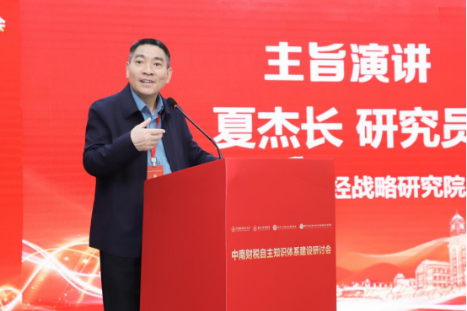
Researcher Xia Jiechang delivered a keynote speech titled Institutions, Technology, and Humanities: Synergizing the High-Quality Development of Service Economics. Noting the shared developmental goals between service economics, public finance, and public economics, he emphasized the need to leverage the synergies of three key elements: institutions, technology, and humanities. While technological progress has enriched product offerings and diversified business models, human warmth, compassion, and emotional support remain core, irreplaceable values. He called for integrating humanistic values, spirit, and care into economic research to drive the high-quality development of these disciplines.
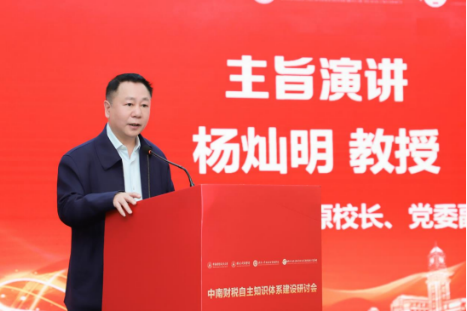
Professor Yang Canming delivered a keynote speech titled Reflections on Professor Wu Junpei's Academic Philosophy. He fondly recalled his nearly half-century friendship with Professor Wu Junpei, dating back to 1980, and shared memorable anecdotes from various stages of their careers. Professor Yang Canming mentioned that the brief yet insightful notes Professor Wu has sent him via WeChat over the past five or six years could now fill a volume, each reflecting profound intellectual brilliance. "In this era, knowledge is the cheapest commodity, while independent thinking is the most scarce." Professor Yang Canming noted that while machines can automate many technical tasks in the age of AI, human self-awareness and original thinking remain irreplaceable. The ability to create "from zero to one" is humanity's ultimate competitive edge. Professor Wu Junpei's dedication to independent thinking and free exploration is a precious intellectual legacy for the public finance and taxation disciplines at ZUEL, one that future generations of scholars should study and carry forward.
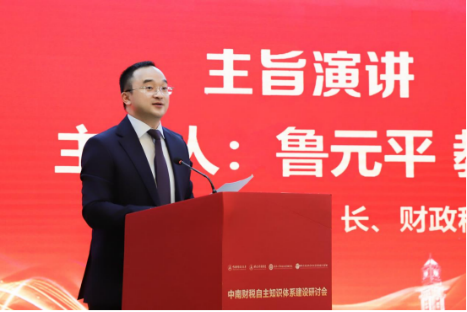
Professor Lu Yuanping, Director of the Academic Affairs Office and Dean of the School of Public Finance and Taxation at ZUEL, moderates the keynote session.
Three parallel sub-forums were held that afternoon, allowing attendees to exchange academic insights and share research findings on developing an independent knowledge system for public finance and taxation.
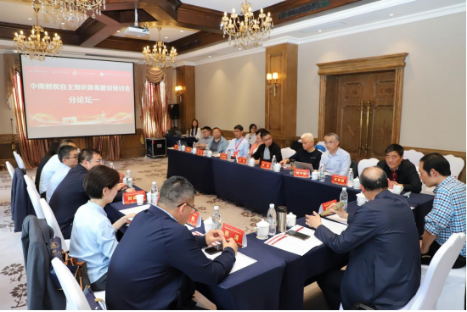
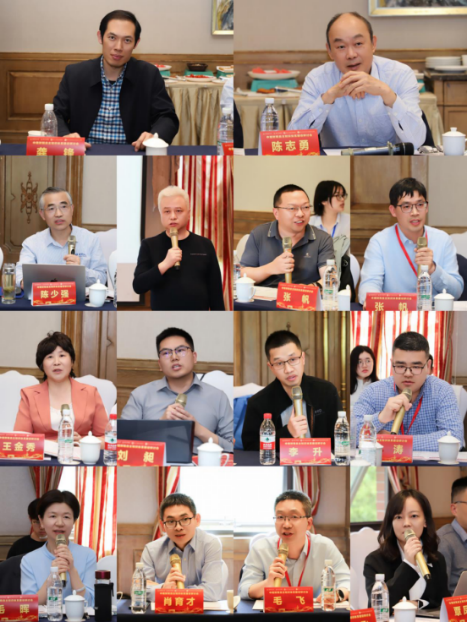
Sub-forum 1
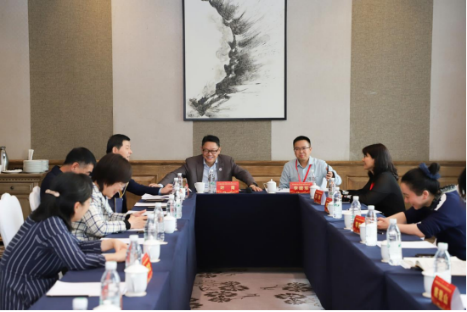
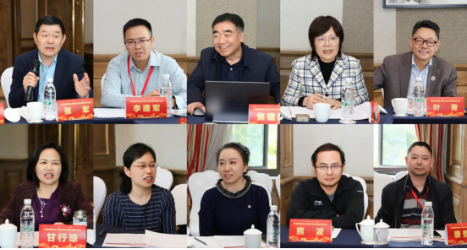
Sub-forum 2
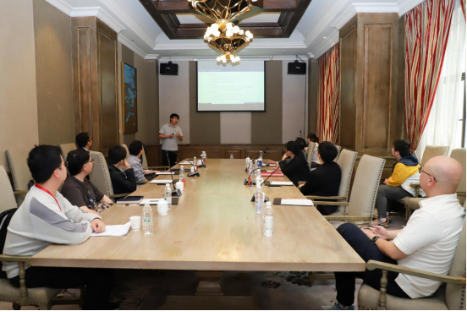
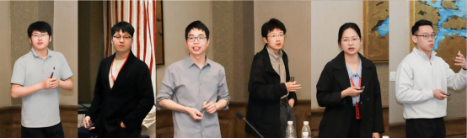
Sub-forum 3
By providing a high-level platform for academic exchange, the successful seminar further solidified the foundation for cooperation in public finance and taxation disciplines at ZUEL. This event holds profound significance for advancing an independent knowledge system and fostering the high-quality growth of these disciplines in the new era. Looking ahead, the national academic community in public finance and taxation will strengthen collaboration to deepen theoretical innovation, advance talent cultivation, and serve national strategies. These efforts will contribute academic wisdom toward building an academic public finance and taxation system with Chinese characteristics, ultimately supporting the modernization of national governance system and capabilities.
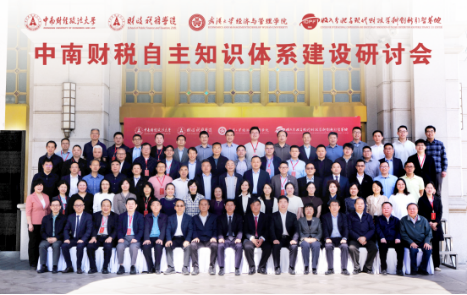
(Correspondents: Liu Pan, Sun Shuo, Gao Siyun; Photographer: Zhong Wei)