
(Correspondent Liao Meng) On April 22, 2026, the 78th Xi Xian Forum took place in Conference Room 119 of Wenqin Building, co-hosted by the Center for International Cooperation and Disciplinary Innovation of Income Distribution and Public Finance, and the School of Public Finance and Taxation at Zhongnan University of Economics and Law (ZUEL). As the keynote speaker, Dr. Gang Jianwei from the School of Statistics and Data Science at Zhejiang Gongshang University delivered a presentation titled AI Applications in Economic Research. Chaired by Liu Erpeng, Deputy Director of the Center for International Cooperation and Disciplinary Innovation of Income Distribution and Public Finance, the forum drew over a dozen attendees, including Center researchers as well as faculty and students from the School of Public Finance and Taxation.
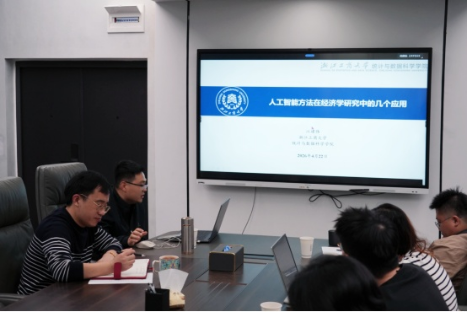
During the forum, Dr. Gang Jianwei systematically explained the core application scenarios of large language models (LLMs) in economic research. He began by highlighting the value of LLMs in quantifying text semantics, noting that they can structure unstructured data to provide reliable data support for various economic research fields. Using personal loan default prediction as a case study, he then illustrated how LLMs enhance data processing. By analyzing, refining, and restructuring borrowers' narratives into standardized, AI-generated text and combining it with traditional financial features, researchers can significantly improve the accuracy of default predictions, opening new avenues for financial risk research. Additionally, he shared an LLM-based method for building an enterprise credit knowledge graph featuring heterogeneous nodes and multiple edges. When combined with graph neural networks, this approach effectively improves early warnings for credit defaults among small and medium-sized enterprises (SMEs), providing a viable technical solution to their credit assessment challenges.

Finally, Dr. Gang Jianwei highlighted the local deployment and inference acceleration of LLMs. Using the Qwen3 series as an example, he demonstrated the entire local deployment process. This provided faculty and students with the practical technical support needed to conduct independent economic research using LLMs, effectively lowering the barrier to utilizing cutting-edge technologies.
Combining theoretical depth with practical value, the forum systematically outlined the diverse applications of AI in economic research and provided actionable pathways for technical implementation. Attendees noted that the forum broadened their research perspectives and provided valuable inspiration for future interdisciplinary studies. Moving forward, the School of Public Finance and Taxation and the Center for International Cooperation and Disciplinary Innovation of Income Distribution and Public Finance will continue to focus on disciplinary frontiers and build more high-level platforms for academic exchange, helping faculty and students explore new methods and pathways in economic research.